




EPSDT: an ounce of prevention (and treatment) for children
The Medicaid Act provides a variety of both services and protections for people with disabilities. One of the populations that benefits the most from Medicaid services is children. Early Periodic Screening, Diagnosis, and Treatment (EPSDT) is a Medicaid benefit designed to increase the duration and scope of treatment provided to children. In doing so, EPSDT requires states to provide nearly any “medically necessary” service to children. From Medicaid.gov:
The EPSDT benefit is more robust than the Medicaid benefit for adults and is designed to assure that children receive early detection and care, so that health problems are averted or diagnosed and treated as early as possible. The goal of EPSDT is to assure that individual children get the health care they need when they need it – the right care to the right child at the right time in the right setting.
Screening
Under EPSDT, states are required to provide a schedule of recommended screenings for medical, vision, hearing and dental. Medical screenings include health and developmental history for both physical and mental health (including substance use disorders), comprehensive unclothed physical exams, immunizations, lab testing, and health education/anticipatory guidance for both children and their caregivers. While states are free to design their periodicity schedule, EPSDT also includes access to screenings that might not fit within that schedule if there is an indication of medical need.
Scope of Services
As stated above, EPSDT is a crucial resource for children with disabilities, providing services that are greater in scope and duration than those provided to all other Medicaid recipients. From Medicaid.gov:
The Act provides for coverage of all medically necessary services that are included within the categories of mandatory and optional services listed in section 1905(a), regardless of whether such services are covered under the State Plan. These include physician and hospital services, private duty nursing, personal care services, home health and medical equipment and supplies, rehabilitative services, and vision, hearing, and dental services.
Further, EPSDT covers “any other medical care, and any other type of remedial care recognized under state law[…]” While the state is free to develop a “State Plan” that describes the services it will commit to cover to its population of Medicaid recipients, that plan does not limit the services a child can receive. Further, any limits to the duration of those services equally do not apply to children, as long as those services are “medically necessary.”
If a child requires twelve sessions of physical therapy, and it is shown that twelve sessions are medically necessary to ameliorate the effects of the child’s disability, then it does not matter whether the state has capped physical therapy services to six sessions. EPSDT requires the state to provide the service to the extent it is medically necessary, regardless of its State Plan limitations.
What do I need to do to get access to EPSDT?
EPSDT is not a waiver program, it is not a specific service, and should not be something that needs to be applied for and approved. It is a Medicaid benefit that is automatically extended to children. That said, your state might require a specific form to request benefits that would only be available because of EPSDT. You should ask your county DHS office for any form they might require to process or approve a specific service, or extension of the duration of a service.
If you are denied a medically necessary service for a child who receives Medicaid, in any form, please call Disability Rights Arkansas at (501) 492-5776.
Thomas Nichols is the Director of Legal and Advocacy Services at Disability Rights Arkansas. Email him at tnichols@disabilityrightsar.org.
Navigating Employment: Empowerment and Advocacy for Individuals with Disabilities
Episode Summary
Have you ever felt the weight of underrepresentation or wondered how to navigate the workplace with a disability? Join us as we bring the conversation to the forefront from the employment team at Disability Rights Arkansas. Wensday, Molly, and Jen discuss their personal journeys navigating employment with a disability. They pull back the curtain on the obstacles faced and their battles for representation, highlighting the triumphs achieved despite the hurdles.
Topics Discussed
- Blasting Through Public Perception in Employment (0:12)
- Advocating for Yourself in the Workplace (11:42)
- Navigating Workplace Inclusion and Resources (25:24)
Listen to the full episode
Resources/Helpful Links
- Resources – Disability Rights Arkansas
- Work Incentives Planning and Assistance (WIPA)
- Arkansas Rehabilitation Services (ARS)
- Division of Services for the Blind (DSB)
Episode Transcript
Transcript of the episode’s audio
Calls to Action
Celebrating 25 Years of Dedicated Service
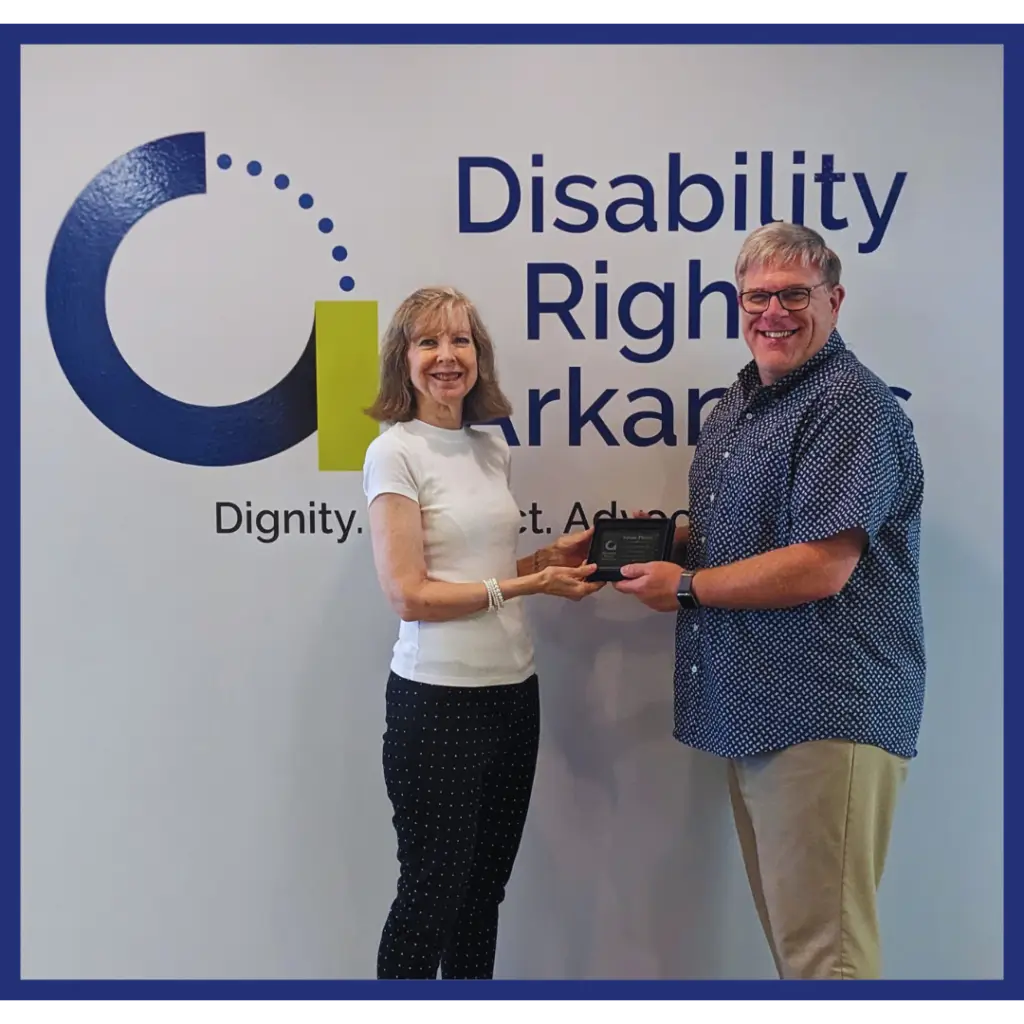
We are so happy to recognize a staff member who has been with the organization for over 25 years. Susan Pierce started at the agency in 1998 as an Intake Coordinator for the Education Program. She spent five years as an advocate on the Abuse and Neglect Team and 8 years as an advocate focusing on housing under the PAIR program.
In 2013, she was the Director of Advocacy. Now has become the guru on submitting our Program Performance Reports, grant applications and an expert in the Disability Advocacy Database program as the Grant Manager. But first and foremost, Susan has been a crucial part to the operations of the agency and strong supporter of disability rights.
Let’s recognize Susan for 25 years of dedicated service.
Advocate Spotlight – Boomer
Boomer and Mollie just celebrated their four-year partnership anniversary! Boomer is a Seeing Eye Dog, and his job is to help Mollie, his handler, safely navigate her environment. Essentially, she needs to know her destination. He guides her around obstacles she cannot see as she gives him directional commands. If Mollie gives Boomer an unsafe command, like crossing a street when a car is coming, he will practice intelligent disobedience. This means he will not obey a command that will endanger the two.

Boomer is a graduate of The Seeing Eye in Morristown, New Jersey. This is where the name “Seeing Eye Dog” comes from. The Seeing Eye School is the world’s first and oldest guide dog school. Not all guide dogs are Seeing Eye dogs; only graduates of Seeing Eye get the title.
Boomer was born on October 15, 2017; at approximately eight weeks old, he went to live with a volunteer puppy raiser for the first year of his life. He learned all his basic obedience skills and excellent manners during this time. Once he was a year old, he was returned to The Seeing Eye for his official guide dog training.
This training usually lasts four to six months and is very extensive. Once Boomer passed all the skills tests with his trainer, he was ready to be matched with Mollie. Mollie spent three weeks training alongside him in Morristown.
This is where they navigated busy streets, shopping areas, revolving doors, escalators, and public transportation, among many other exciting training adventures. Mollie likes to say that she can take Boomer anywhere anyone else can expect to take their eyes. However, there are some limited exceptions. For instance, there are some sterile hospital environments where he cannot go. But generally speaking, Boomer can go everywhere with Mollie.
There are many reasons why the general public should ignore a service animal like Boomer. First, his work requires a lot of focus. Although petting seems harmless, it can distract the animal and the person they are supporting. If either of them loses focus, it can put both in danger. Second, Mollie constantly rewards Boomer with praise and pets as he works. This positive affection is an incentive for him to continue his good work. If he were to receive this praise from others constantly, it would reduce its effectiveness from her. Let’s think about it, would you be motivated to do your best work if you knew someone other than your employer would be paying you for just being adorable? I don’t think so! Allowing someone to pet a service animal is always at the handler’s discretion. If the time is right, the handler may slip off the harness and allow a quick pet or snuggle session. But please do not touch the animal while they are working.
Boomer does not eat anything other than his dog food and dog treats. This ensures he maintains a healthy weight for a long and healthy life. It is also to prevent bad table manners. If allowed table scraps at home, he might scavenge for food as he dines in restaurants with his handler. He does love ice as an extra treat. If he hears someone in his family kitchen getting ice from the refrigerator, he makes sure to get there in time for a piece to be tossed to him! It’s not always work for Boomer.
He works hard, but he plays even harder! When they are at home, Boomer is a typical dog. Mollie does not need him to help her navigate her house. This means he clocks out and enjoys being a pet. He loves all the toys, especially the crackly toys with long appendages he can shake or play tug with. Most squeakers don’t last long with him. Boomer also loves chasing tennis balls outside. His best friend is a very large Great Pyrenees named Joy.
Mollie loves to talk about Boomer and educate people about Seeing Eye Dogs. If you want to learn more about Seeing Eye Dogs, check out seeingeye.org.
A big thanks to Boomer for being the Advocate of the Month!
Do you know someone special who is making a difference in their community? Nominate a person with a disability, an ally to the disability community, or someone that is working hard to support people with disabilities so we can highlight their work and achievements. The Arkansas Alliance for Disability Advocacy wants to spotlight them in our newsletter.